- Monument, Realraum [Real space, Monument]
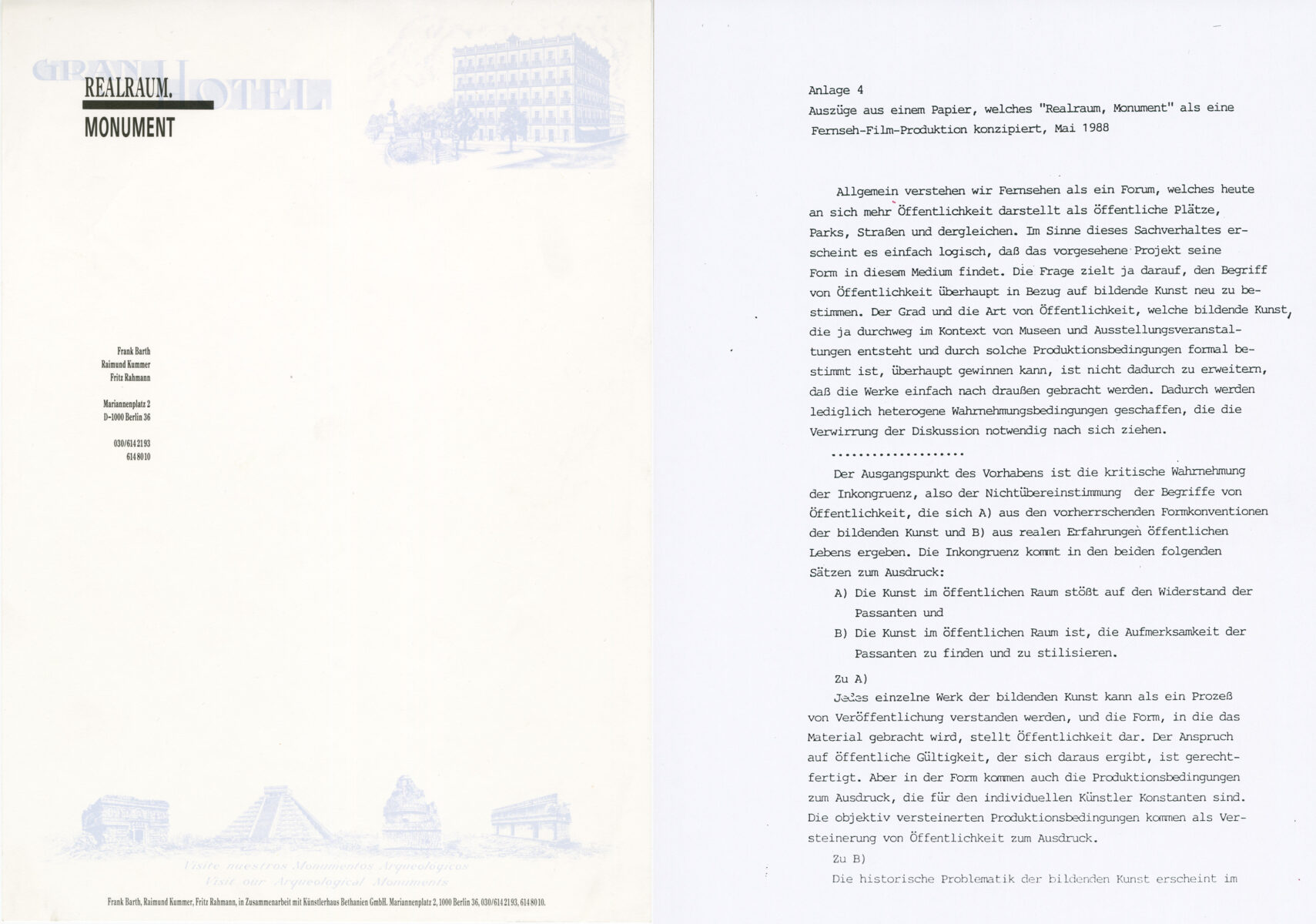
Between 1987 and 1989, Raimund Kummer, Fritz Rahmann and Frank Barth developed the concept for an ambitious, superordinate art project. The center of the debate was to clarify the two terms "monument" and "real space" which gave the project its title. The first steps were a conference at the Hotel Gellért, Budapest, the setting up an office in the Künstlerhaus Bethanien and the rooms of the company alert Film GmbH, as well as the continuous conversation with the publicist and publisher Hans Werner Holzwarth.
In the 1980s it had become evident that in the context of commissioning public art ("Kunst im öffentlichen Raum", Hamburg since 1981; exhibitions in Parkgelände Sonsbeek 1986; "Skulpturenmeile Hannover", 1986; "Skulpturenboulevard", Berlin, 1987; "documenta", Kassel 1987; "Skulptur, Projekte", Münster, 1987; Folkwang 87, Essen) a political interest in the production of artistic work in public spaces had developed throughout Europe. BÜRO BERLIN had sufficient knowledge of relevant production conditions in public space that had previously tended to exclude the idea of monuments. The motto pursued by BÜRO BERLIN since its founding in 1980, "Every place could be a place for art," had necessarily led to the development of ephemeral art forms in the practice of the following years. In its distinctly general conception of the site-specific possibilities of art, this approach continued to retain its validity in the issues now under discussion.
To this purpose, it was considered essential to initiate a conversation with theorists and experts from the fields of art, sociology, economics, law, and politics, including Niklas Luhmann, the economist Ernst Pitz, the film producer Alfred Hürmer, the publisher Hans Werner Holzwarth, and others. The questions raised were, for example, whether there are any liabilities at all in the social discourse to think about the term "monument". What pathos formulas of the monumental were socially understood and what status do they assume in the confrontation with the aesthetic qualities of real space, in short: "What does monument mean today?" The results of the examination of the questions were to be presented in the form of a TV film. Television seemed to be the appropriate medium to demonstrate the nature of work in public space. These considerations were inspired by the radio play "The War of the Worlds" by Orson Welles. Unfortunately, no intended further collaboration with other artists took place. The cause lay in a momentous failure to take into account the unequal distribution of power among the authors involved and BÜRO BERLIN's continued dependence on funding agencies.
In contrast to Kummer and Rahmann, Frank Barth had a dual role. He was both a representative of Künstlerhaus Bethanien and thus a recipient of the project funds, as well as a co-author of the project. BÜRO BERLIN failed to recognize this situation. The conflicts characteristic of any artistic collaboration due to diverging objectives now became a problem, as the project was driven to a standstill by the dual-interest representative and his abuse of power. This contradiction could not be resolved despite several attempts to find a solution.
Only with the acquisition of a new grantee, the old familiar Berlin Artists' Program of the DAAD, did it seem possible to continue the BÜRO BERLIN project. However, before a new contract could be signed, the political events of 1989/1990 finally put an end to the continuation of the project. In 1989, the real space had unexpectedly received a model answer to the question "What does monument mean today?": The fall of the Berlin Wall. Due to the accompanying social and political changes - and also a change in the awarding practice - the project was not continued by the funding institutions.
Fritz Rahmann continued to work independently on the project and created a comprehensive archive of texts, notes, photographic and audio material. Further information is listed in the Rahmann catalog raisonné and can be researched in the artist archive of the Berlinische Galerie.
- Further material
- Project Paper
- Correspondence
- Konferenz Hotel Gellért, Budapest